Why do we have fuses in plugs?
A conversation on Mastodon was discussion which started as to why the USA have communal laundry rooms in their apartment blocks and diverged into a discussion on UK home wiring, this raised the question. Why does the UK have fused plugs and how does everyone else manage without?

Looking around my house, I realised that not everything that fits in the socket has these cartridge fuses. And I think this is a big clue to why the fuses are there.
It is because of the ring main.
One commenter was insistent that the reason the fuses were there was because of the ring design of our socket wiring. This statement is repeated around the internet, but it didn’t seem like the whole answer to me as there’s nothing inherent the ring topology which means we need fuses. But they did helpfully add that direct to cabinet designs didn’t have a fuse. Looking at UK cooker wiring that is the same in that often wired directly and doesn’t have a fuse although often with a large isolator switch near the appliance.
Wiring topologies
Some countries such as Singapore have a direct to cabinet approach, you can see this in their consumer units, lots and lots of circuits. Each circuit supplying one socket.
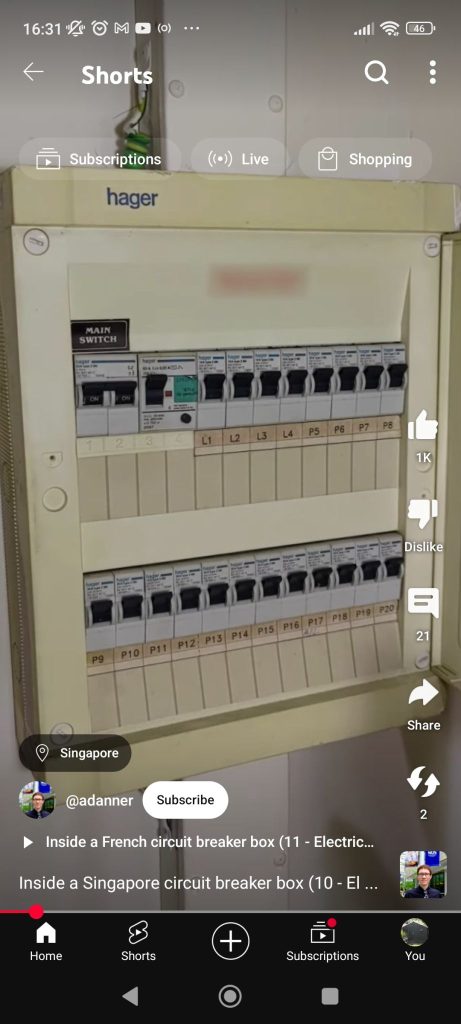
In my research into this topic, I discovered Aaron Danner who has lots of great videos on electricity and electronics including several looking at different countries consumer units.
In the UK we have a mix of ring and radial. In the ring topology there is a wire from the consumer unit which supplies several sockets and then returns to the consumer unit in a loop hence the ring name. This topology means thinner cables can be used as the load is shared between two wires. And multiple appliances can be connected to the one circuit.
In the radial topology there is a wire from the consumer unit to the first socket, this then goes to the next and so on. So each circuit supplies several sockets and there are fewer circuits. Here’s a fairly modern example but older examples had even fewer circuits, typically 2 rings for upstairs and downstairs, a cooker circuits and one or two lighting circuits.
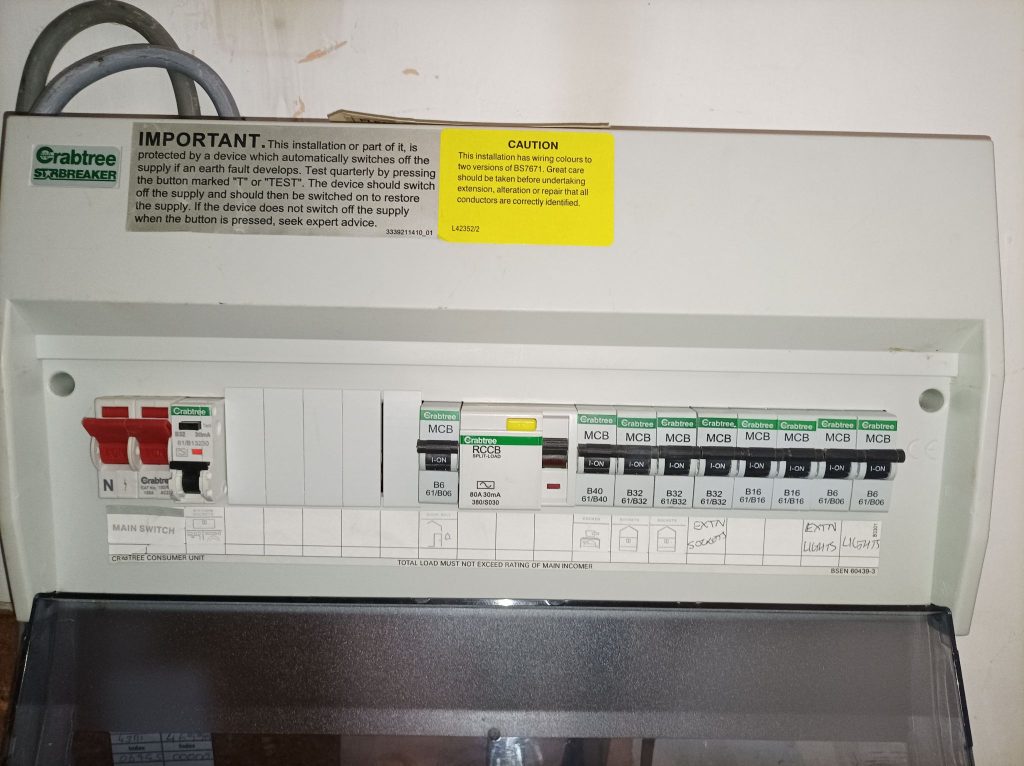
The UK consumer unit in my house
So given that these circuits need to supply lots of power they typically have 32A breakers on them. Looking at Singapore their breakers are 20A and a quick check for the USA shows that they are also 20A or in some cases 15A.
So this is why there is a need for a fuse, it is there to protect the cable running between the plug and the appliance. The alternative would be to have 32A tolerant cables on every device. The other countries don’t need protective devices as their circuit, breaker is more closely rated to the appliances. It also shows why we don’t need a plug in the phone charger, it has no input cable to protect.
It is also worth mentioning the earth wire, that provides an easy path to complete the circuit in the case of faults. When such a fault occurs and the live cable touches an exposed metal component, then a large current can flow through the earth wire, causing the fuse to blow.
Why this topology?
To understand why we have ring/radial topology we need to look back in time. Shortly after World War II, an IEE committee published a study into electrical installation, “Post-War Building Studies no. 11: Electrical Installations” . One of the key members of that committee was Caroline Haslett, who wanted those Women engineers who had contributed so much during the war to be able to continue their roles. She recommend the use of labour saving devices around the home. And to be able to power those devices the house’s installation would need increased power capability and plenty of sockets.
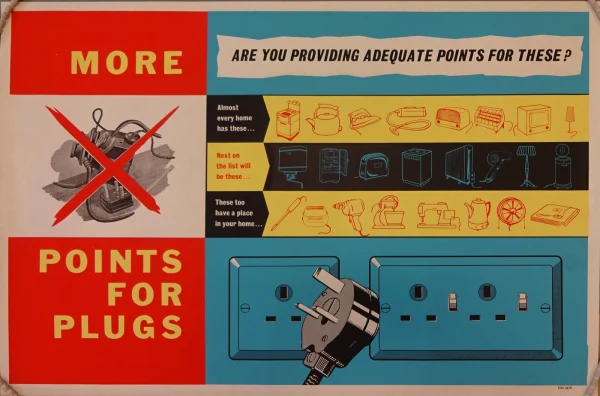
The committee also understood that resources were scarce following the war so designed a ring topology which would allow 2 cables to supply each socket hence the cable thickness could be thinner. Domestic buildings would typically have one socket circuit per floor so a house could supplied from a small consumer unit or “fuse box”. The fuses were re-wireable, so it was common place to have a card full of fuse wire in a drawer in UK houses.


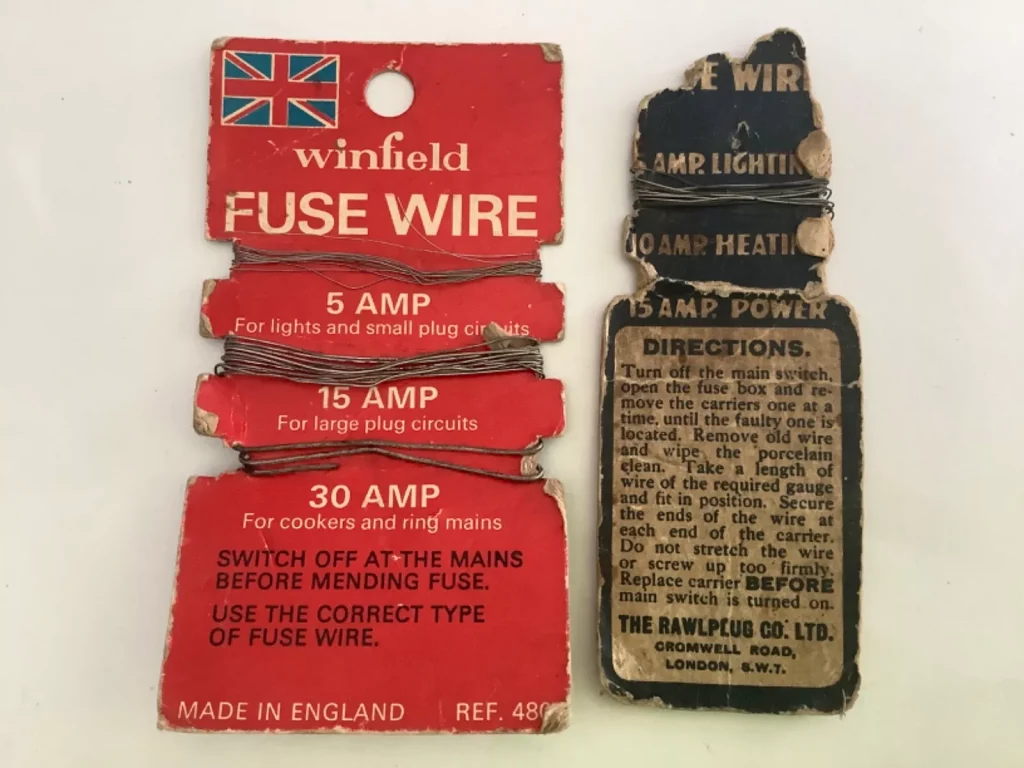
It was a pain to replace the fuses as you had to turn off the power to the whole house and re-wire the fuse by candle or torch light. And there was nothing to stop a user putting the wrong sized wire in the fuse holder. So the wiring regulations were upgraded and most houses have miniature circuit breakers which electronically measure the current and rapidly break the circuit in the case of a fault.
So what about the devices without fuses?
The fuses in UK plugs are 13A for large appliances and 5A or 3A for smaller devices. And as shown above there are certain devices such as AC to low voltage DC that don’t have fuses, sometimes known as “wall warts”. The key feature of these is that they have no wire between the device and the plug, so there is no wire to protect. As the only output is low voltage these devices often don’t have an earth either. These devices have multiple layers of casing to protect the user from any possibility of exposure to high voltages. They are known as Class II electrical appliances or “Double insulated” and should be recognisable by a symbol of a square inside a second square printed on the device.
Note that some class II devices also have a fused cable such as a drill or hairdryer. Here the manufacturer has decided to provide protection to the user/appliance by the insulation. This means they can supply the same appliance with different cables to countries without an earthed plug.
The final bit of electrical safety equipment which is worth mentioning is the residual current device or RCD. These are sometimes known as an earth leakage breaker or ground fault circuit interrupters. These look for a mismatch of current going in to a circuit and current coming out of the circuit. And if the current is out by more than a few mA the circuit breaks.
An RCD can also be combined with an over current protection and in that case are called RCBO or RCCB, you can see both types in my consumer unit above.
So in summary, the UK has fuses in their plugs so they can do their laundry at home.
 Posted in: Inspiration




 Metal sculpture in brass, mounted on an 1800s French Coin